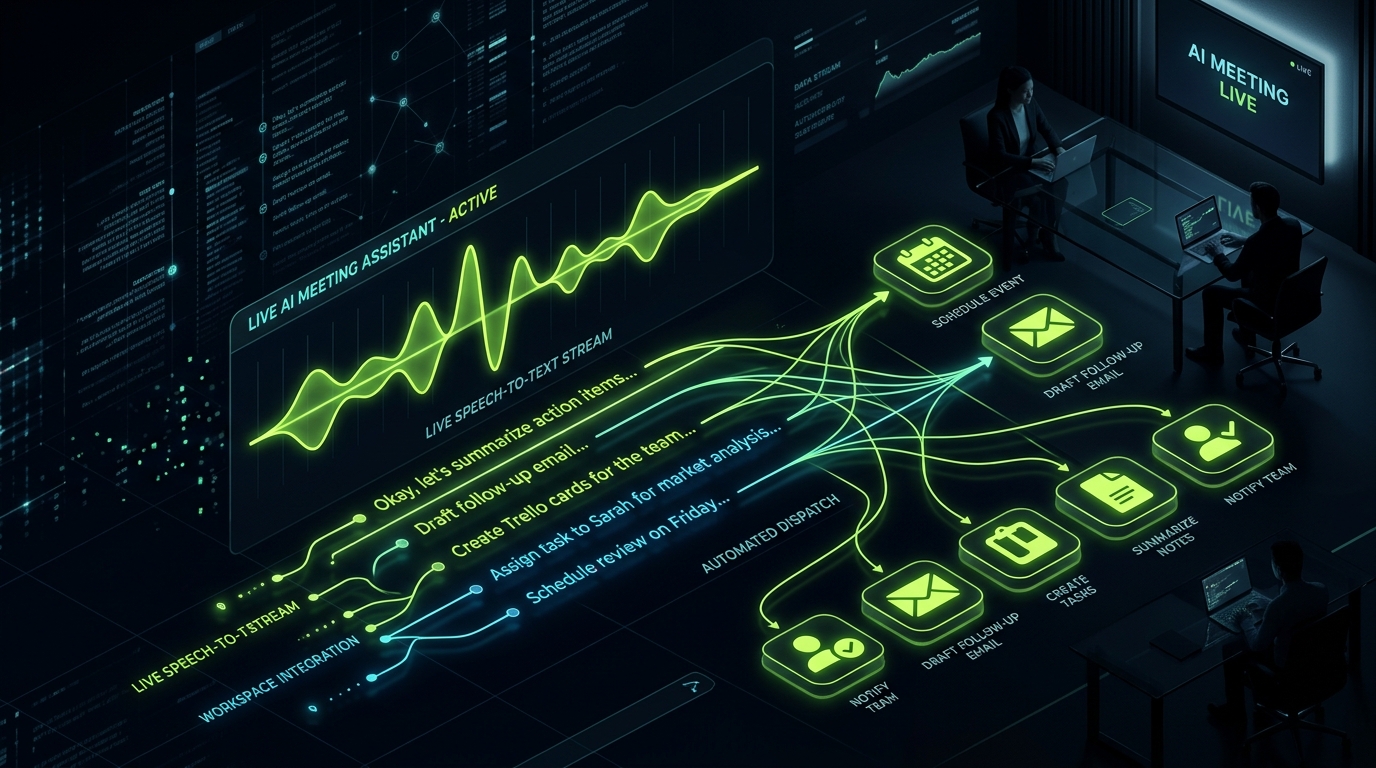
The meeting intelligence space is experiencing explosive growth. Over the last three years, the convergence of high-accuracy speech-to-text models (Whisper v3, Deepgram Nova-2), fast LLM inference (Claude 3.5 Sonnet, GPT-4o, Groq), and seamless desktop audio loopbacks has created a massive multi-billion dollar category led by Granola, Otter.ai, Fireflies.ai, Wispr Flow, Fathom, Supernormal, and Plaud.ai.
In this deep dive, we break down the $2.5B+ market dynamics, examine how today's leading products capture and process conversations under the hood, analyze the hardware vs. software momentum, and walk through the engineering of a real-time multi-connector sync engine.
1. The $2.5B+ Market Map & Revenue Dynamics
Meeting intelligence and conversational AI has grown into one of the most commercially viable sectors in applied AI:
- Market Scale: Valued at $2.5B+ in 2026 and expanding toward $10B+ by 2030 (28%+ CAGR).
- B2B Enterprise Contracts: Priced at $15 to $35 per user per month. A 500-seat technology organization routinely commits $100,000 to $180,000 ARR for company-wide meeting transcription, intelligence, and CRM sync.
- Hardware Surge: Hardware wearables like Plaud.ai have generated over $40M+ in top-line revenue within 12 months, bundling $159 physical cards with recurring cloud AI subscriptions.
| Product Category | Primary Leaders | Capture Mechanism | Typical Pricing | Core Value Proposition |
|---|---|---|---|---|
| Cloud Bot Recorders | Otter.ai, Fireflies.ai, Read.ai | Virtual SIP / WebRTC Bot | $15–$25 / user / mo | Automated call recording & searchable archive |
| Local OS Audio Taps | Granola, MacWhisper | CoreAudio / WASAPI Loopback | $10–$18 / user / mo | Bot-free native UX, editable AI notes |
| Voice-First Dictation | Wispr Flow, Superwhisper | OS Hotkey Voice Stream | $12–$20 / user / mo | 3x faster voice-to-text with auto-formatting |
| Dedicated Hardware | Plaud Note/Pin, Limitless | Dual-MEMS Wearable + BLE | $159 HW + $10/mo Cloud | In-person physical meeting & phone call capture |
| Multi-Connector Systems | Enterprise Custom Engines | Dual-Loop Streaming Pipeline | $25–$45 / seat / mo | Live in-call assistance + multi-tool sync |
2. How Today's Leading Systems Work Under the Hood
Beneath the sleek interfaces, modern meeting assistants operate across three coordinated technical layers:
[Audio Ingestion] ──────> [Streaming STT & Diarization] ──────> [LLM State Compilation] ──────> [Workspace Sync]
(Loopback / Bot / HW) (Deepgram Nova-2 / Whisper v3) (Claude 3.5 / GPT-4o) (Notion / Slack / Linear)- 1. Audio Ingestion Layer:
- WebRTC / SIP Bots: Automated headless browser instances (often orchestrated via Recall.ai or custom Puppeteer fleets) join meetings, record incoming audio tracks, and emit RTMP/PCM streams.
- OS Audio Loopbacks (Granola / Wispr Flow model): Native macOS/Windows applications tap system output audio plus local microphone input directly from the OS audio bus without requiring any external bot to join the call.
- 2. Speech-to-Text & Acoustic Diarization: Audio is chunked into 3-to-5 second sliding windows and processed through modern STT models (Deepgram Nova-2, Whisper v3), performing acoustic speaker separation with sub-500ms latency.
- 3. Contextual State Compilation: The transcript stream is processed by high-context LLMs to extract chronological key points, decisions, and action items.
3. The Hardware vs. Software Wave
The meeting AI boom has catalyzed significant innovation across both hardware form factors and software interfaces:
- Physical Presence: Capturing in-person boardroom discussions, coffee chats, walking 1-on-1s, and mobile phone calls where no laptop is active.
- Acoustic Engineering: Dual-MEMS beamforming and physical vibration conduction sensors ensure near-field vocal clarity even in noisy environments.
Concurrently, software-first tools like Granola and Wispr Flow have achieved massive adoption by eliminating hardware friction entirely—providing instantaneous, zero-install audio capture and rapid voice-to-text formatting directly within existing desktop workflows.
4. The Next Evolution: Dual-Loop Architecture & Multi-Connector Sync
To transition from post-call summaries to real-time workflow orchestration, next-generation architectures employ a Dual-Loop Engine:
- 1. The Fast Hot-Loop (<500ms): Ingests short audio bursts to provide instant in-meeting assistance, search company documentation, and answer participant questions on the fly.
- 2. The Rolling Cold-Loop (60s State Differential): Updates a cumulative meeting state graph every 60 seconds—extracting decisions, topics, and assignees while slashing prompt token consumption by over 75%.
- 3. The Multi-Connector Dispatcher: Maps compiled meeting states directly into native API schemas for Notion (database pages), Slack (rich Block Kit channel digests), and Linear (structured engineering tickets).
5. Key Takeaways
The rapid growth of the meeting intelligence market demonstrates the power of combining ambient voice capture with intelligent LLM state compilation.
As audio capture methods become ubiquitous—across both local software loopbacks and dedicated hardware form factors—the definitive competitive advantage lies in real-time dual-loop responsiveness and seamless multi-connector execution across the enterprise software stack.